Leadership and The Trust Ladder: How Leaders Build Teams Without Losing Control
For the past few weeks, I’ve been telling the story of Claire and Paul—two business owners wrestling with leadership challenges. Their struggles show what so many leaders face: the tug-of-war between letting go and holding on, between building trust and protecting results.
Their story isn’t fiction—it’s a mirror. I use Claire and Paul to put words and pictures around what so many leaders are facing: the tug-of-war between letting go and holding on, between building trust and protecting results. Each week, I share the next “episode” of their journey—not because their names matter, but because their struggles mirror what so many leaders face.
If you’ve been following along, welcome back—you know exactly where we left off.
If this is your first time meeting Claire and Paul, you can catch up on the full storyline here: [Claire & Paul Story Archive Landing Page].
And if you want to keep learning from their wins, mistakes, and breakthroughs in real time, join the leadership community email—it’s where the next chapter always drops first: [Sign Up for the Leadership Community Email
].
Claire and Paul’s Latest Leadership Move
Claire thought she was finally breaking free in her leadership. She’d stopped chasing every detail and started focusing on the big goals that really mattered.
Paul thought he was finally catching a break in his leadership. Mike had stepped up with an idea, and for once, Paul didn’t have to be the guy with all the answers.
On paper, both leadership moves looked smart.
In practice? Both went sideways.
-
Claire’s team froze. Instead of running with her goals, they defaulted to Slack therapy sessions, CC-all emails, and “urgent” pings at 10 p.m.
-
Paul’s crew revolted. Mike’s idea landed with a thud, and productivity dropped like a rock.
Different leaders. Same truth: delegation without trust doesn’t create freedom—it creates fires.
Why Leadership Without Trust Feels Like Gambling
Claire sat at her kitchen table, staring at her buzzing phone, thinking:
“I wanted freedom. What I got was more fires and more guilt.”
Paul sat in his truck, flipping through invoices, thinking:
“If this is leadership, I must’ve signed up for the wrong class.”
Both were wrestling with the same fear:
What if trusting my team costs me everything?
That fear is real. And it’s why so many leaders keep holding on too tightly. Because without a process, trust feels like handing your teenager the Bentley keys and hoping they don’t find the turbo button.
The Real Cost of Not Building Trust
When leaders skip the process of building trust, here’s what it really costs:
-
Turnover: Half of employees leave because of trust gaps. Replacing a $60K employee can cost $90K–$120K.
-
Rework: Low-trust teams waste 20–30% of payroll fixing mistakes and waiting for approvals. That’s $200K lost per year in a 20-person company.
-
Lost Clients: Two missed $50K contracts = $100K gone. Not because of the product—but because of the team’s dysfunction.
-
Owner Burnout: Nights, weekends, and sanity drained by babysitting instead of leading.
The cost of not building trust isn’t hidden. It’s already on your books—you just haven’t given it a line item.
The Trust Ladder: A Leadership Framework for Delegation
So how do you delegate without gambling the business?
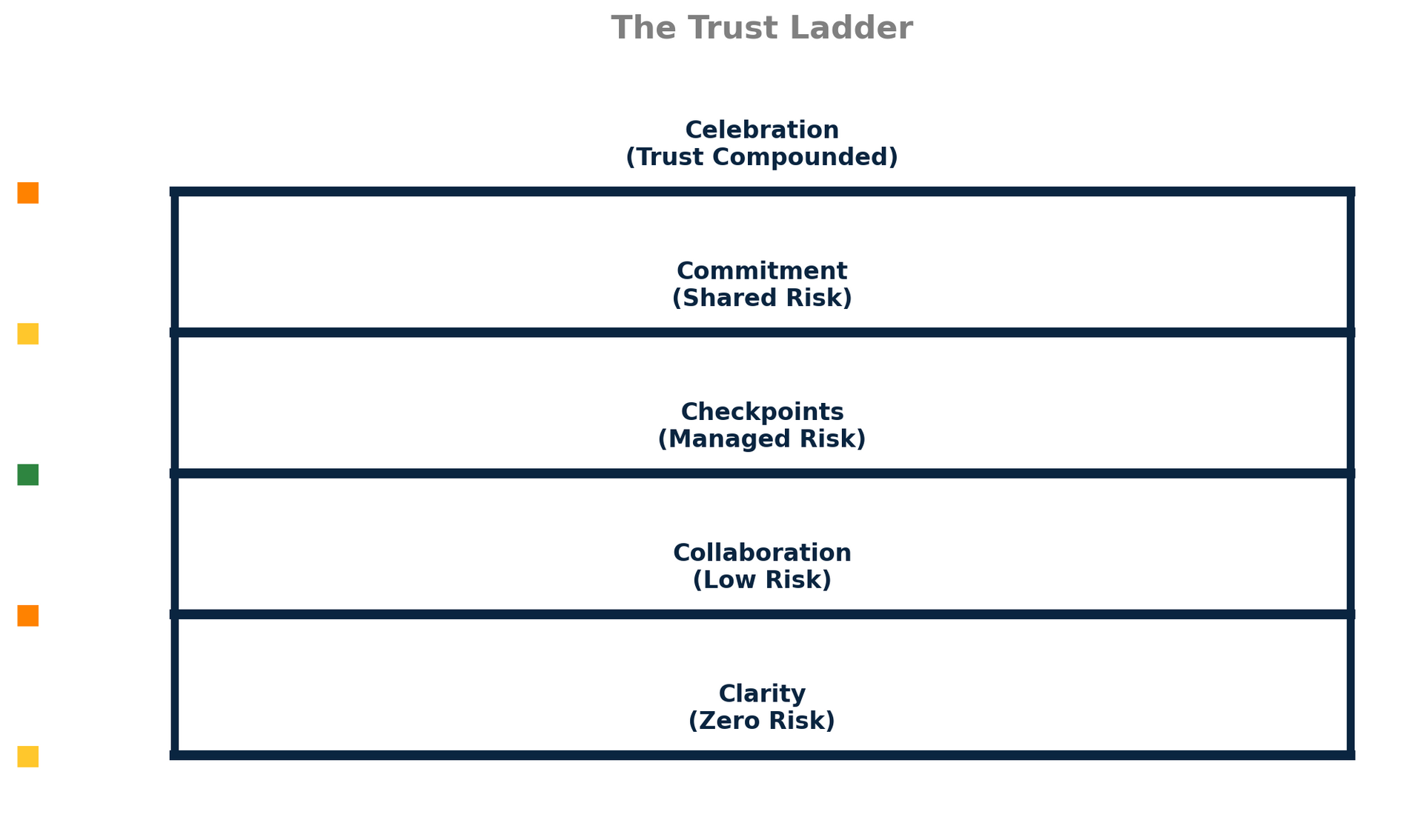
You climb the Trust Ladder
—one step at a time.
Here’s how it works:
-
Clarity (Zero Risk) – Define the outcome. Don’t hand over a “task,” hand over a picture of success. Example: instead of “make a slide deck,” say “by Friday I need a 10-slide deck that explains our new product in plain English.”
-
Collaboration (Low Risk) – Let them design how to get there. You hold the “what,” they own the “how.” Example: ask “what’s your plan?” and listen before you jump in.
-
Checkpoints (Managed Risk) – Set one or two non-intrusive reviews. Progress beats surprises. Example: a 15-minute check-in midweek, not a micromanaged daily report.
-
Commitment (Shared Risk) – Publicly give them ownership. Accountability multiplies when others are watching. Example: “Sarah owns this client deliverable. If you have questions, go to her, not me.”
-
Celebration (Trust Compounded) – Even imperfect wins build momentum. Trust compounds when leaders acknowledge progress. Example: “That wasn’t flawless, but you took ownership and carried it through. That matters.”
Notice how each rung carries a little more risk but also builds more trust. The goal isn’t to hand over the Bentley all at once. It’s to move from bicycle → side street → freeway—at a pace that keeps your business safe.
Scaling the Trust Ladder Across a Team
“But John, I don’t have time to run every employee up the ladder one by one.”
Exactly. That’s why you scale it:
-
Start with Early Adopters — 1–2 proven people.
-
Climb Publicly — Let the whole team see how trust is earned.
-
Create Trust Multipliers — Those early adopters become mentors for others.
-
Install Guardrails — SOPs, checklists, and scorecards make trust repeatable.
-
Move to Rhythms — Weekly or bi-weekly check-ins replace constant interruptions.
This way, you’re not babysitting 10 people—you’re building a culture of trust that scales itself.
When the Dust Settled
Paul’s relief was short-lived when Mike’s “brilliant” idea hit the field. The checkpoints kept it from crashing completely, but the crew still questioned whether Mike deserved the wheel — or if Paul was just setting them up for failure. Trust with Paul was shaky. Trust with each other? Even thinner.
Claire’s team, meanwhile, managed to deliver on one of her big goals — but just barely. The project stumbled across the finish line like a runner collapsing at the tape. Instead of celebrating, the team quietly avoided eye contact, afraid of disappointing her again.
Both leaders realized the same gut-punch truth: you can’t build results on a foundation of weak relationships.
And that’s where leadership gets real. Because when trust cracks inside a team, it’s not just productivity at risk — it’s the culture, the confidence, and the future.
Stay tuned — because next week, Claire and Paul discover that processes may keep the wheels turning, but relationships are what make the engine run.
WholeLife Leadership: Your Next Step
That’s why I created WholeLife Leadership.
In just 3 days, you’ll walk away with:
Frameworks like the Trust Ladder to minimize risk and accelerate trust.
Tools to align people, processes, and profits.
A leadership blueprint to free you from firefighting.
Seats are $97 until 9/10/25—then the price goes up.

Because courage without process is just risk.
But courage with process? That’s leadership.
The post Leadership and The Trust Ladder: How Leaders Build Teams Without Losing Control appeared first on John Whitt Business Coaching.
Recent Posts